By: News Desk 92Pavilion | Updated: August 2026
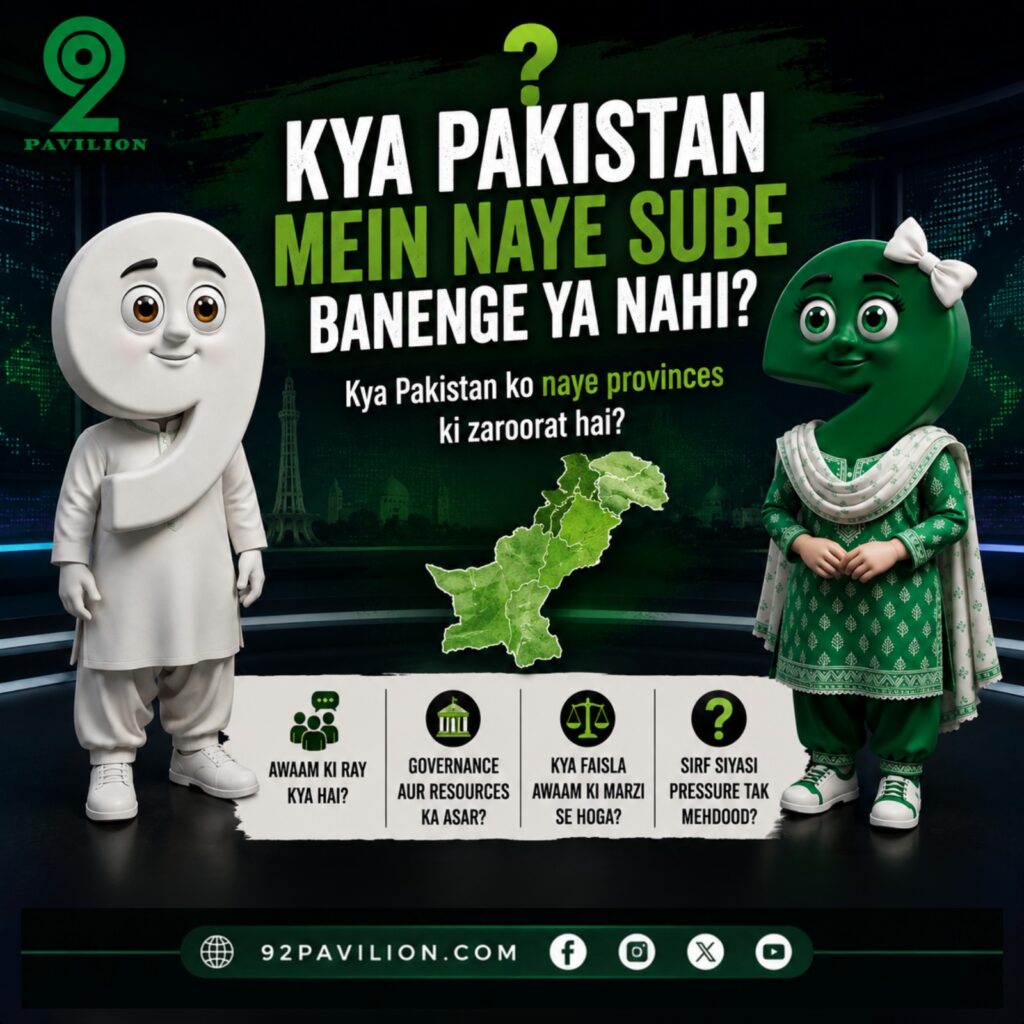
Pakistan is talking about new provinces again. This isn’t a new topic. But it has come back with real force this time.
Federal Interior Minister Mohsin Naqvi restarted the conversation. He spoke at the Pakistan Economic Summit on July 30, 2026. He said the country’s governance system had “collapsed.” He called for political consensus on new administrative units.
That single comment set off weeks of reaction. Party leaders, provincial assemblies, and social media users jumped in. A viral map even started circulating. It showed Pakistan split into 17 provinces. The map wasn’t official. But it captured how fast the idea spread.
Why This Debate Never Fully Goes Away
Pakistan’s provincial map hasn’t changed much since independence. Yet calls for new provinces stretch back decades.
The Hazara movement began after a major shift in 2010. That year, the North-West Frontier Province was renamed Khyber Pakhtunkhwa. People in the Hazara division protested. They wanted their own separate identity. The movement never fully faded.
South Punjab has its own long history too. In 2012, the Punjab Assembly passed a resolution. It supported creating provinces for South Punjab and Bahawalpur. A constitutional amendment bill followed in 2013. It passed the Senate under the PPP government. It failed in the National Assembly, though.
Years later, the PTI government took a smaller step. It created separate secretariats in Multan and Bahawalpur. Officials saw this as groundwork for a future province. A full province, though, never materialized.
Where Each Major Party Actually Stands
This is where things get complicated. Almost every party talks about new provinces. But their positions differ sharply depending on the region.
PPP supports a South Punjab province. It has said so for years. But the party firmly opposes dividing Sindh. PPP leader Qasim Gilani recently backed Naqvi’s remarks. He said Pakistan runs on a system built for a different century.
PML-N has shown mixed signals. Some of its leaders back a Hazara province. Federal Minister Mohammad Raza Hayat Harraj expressed personal support for South Punjab on a television show. But a widely shared claim said PML-N and PTI had officially agreed on new provinces. Fact-checkers reviewed that claim. They found it misleading. A television discussion isn’t the same as a party decision.
PTI has generally supported the idea. Senator Azam Swati says Imran Khan holds a clear pro-province stance. PTI Chairman Barrister Gohar Ali Khan also backed the concept publicly. Still, not everyone in the party agrees. PTI leader Dr. Humayun Mohmand pushed back. He argued that stronger local government could fix these problems instead. He warned that smaller provinces might bring more corruption, not less.
ANP stands firmly against a Hazara province. The party has opposed the idea since it first emerged.
JUI-F takes a cautious middle path. Maulana Fazlur Rehman said his party supports new provinces in principle. But he added that no real consensus exists right now. He called the current debate a distraction from bigger issues.
IPP has taken the boldest position. Its president, Abdul Aleem Khan, wants each existing province split into four units. That would include Hazara, South Punjab, and Bahawalpur as separate provinces. He’s urged other leaders to stop protecting their regional influence.
MQM-P has proposed something different: a national dialogue. Its leader questioned whether real public demand exists outside the Hazara movement. He suggested a structured framework instead of scattered proposals.
What Supporters and Critics Both Argue
People backing new provinces make a fairly simple case. Smaller administrative units bring governance closer to citizens. Resources and services become easier to manage. Healthcare, education, and public offices could reach smaller towns faster.
Critics raise a different concern. They say Pakistan’s problems run deeper than province size. Corruption, political patronage, and weak institutions exist everywhere. Creating new boundaries alone won’t fix those issues, they argue. Some worry new provinces could simply multiply existing problems instead of solving them.
Why Sindh Remains the Hardest Question
Most of this debate focuses on Punjab and Khyber Pakhtunkhwa. Sindh is different.
PPP has consistently rejected any division of the province. PML-N’s Sindh leader, Kheel Das Kohistani, echoed that stance recently. He said the people of Karachi don’t want their province split. He insisted such decisions belong to local residents and their assemblies, not federal officials.
This resistance makes Sindh the most politically sensitive part of the entire debate.
The Legal Reality Nobody Can Skip
Here’s something worth understanding clearly. New provinces can’t be created through a press conference or a television debate.
Pakistan’s constitution sets a high bar for this kind of change. It requires a two-thirds majority in Parliament. It also requires approval from the relevant provincial assembly. Both steps must happen. Neither can be skipped.
This explains why the 2013 constitutional amendment bill failed. It cleared the Senate. It never got enough support in the National Assembly. Political talk is one thing. Passing an actual constitutional amendment is far harder.
So, Will It Actually Happen?
Right now, no formal legislation is moving through Parliament. What exists is political discussion, competing statements, and public pressure building across social media.
Some form of consensus does appear to be emerging around a few ideas. South Punjab and a Hazara province face less overall resistance than the Sindh proposal. But “less resistance” isn’t the same as agreement. Real disagreement remains over final boundaries, timing, and whether restructuring solves anything at all.
For now, this remains what it has been for over a decade: a debate that resurfaces, gains momentum, and then stalls against the same constitutional and political hurdles.
Frequently Asked Questions
Is Pakistan officially creating new provinces?
No formal legislation currently exists. This remains a political debate, not a confirmed plan.
Which new provinces have the most political support?
South Punjab and Hazara face relatively less opposition than proposals to divide Sindh.
What does the law require to create a new province?
A two-thirds majority in Parliament and approval from the relevant provincial assembly are both required.
Do PML-N and PTI officially agree on new provinces?
No. A viral claim suggested this, but fact-checkers found it misleading. Individual comments aren’t the same as an official party position.
Why does PPP oppose dividing Sindh but support South Punjab?
PPP has long backed a South Punjab province while treating Sindh’s unity as a separate, non-negotiable issue.
This report is based on reporting from Voicepk.net, Aaj English, The News, Soch Fact Check, BOL News, and Pakistan Observer.
92Pavilion breaks down the political stories shaping Pakistan’s future. Stay with us for continued coverage.