By: News Desk 92Pavilion | Updated: August 27, 2026
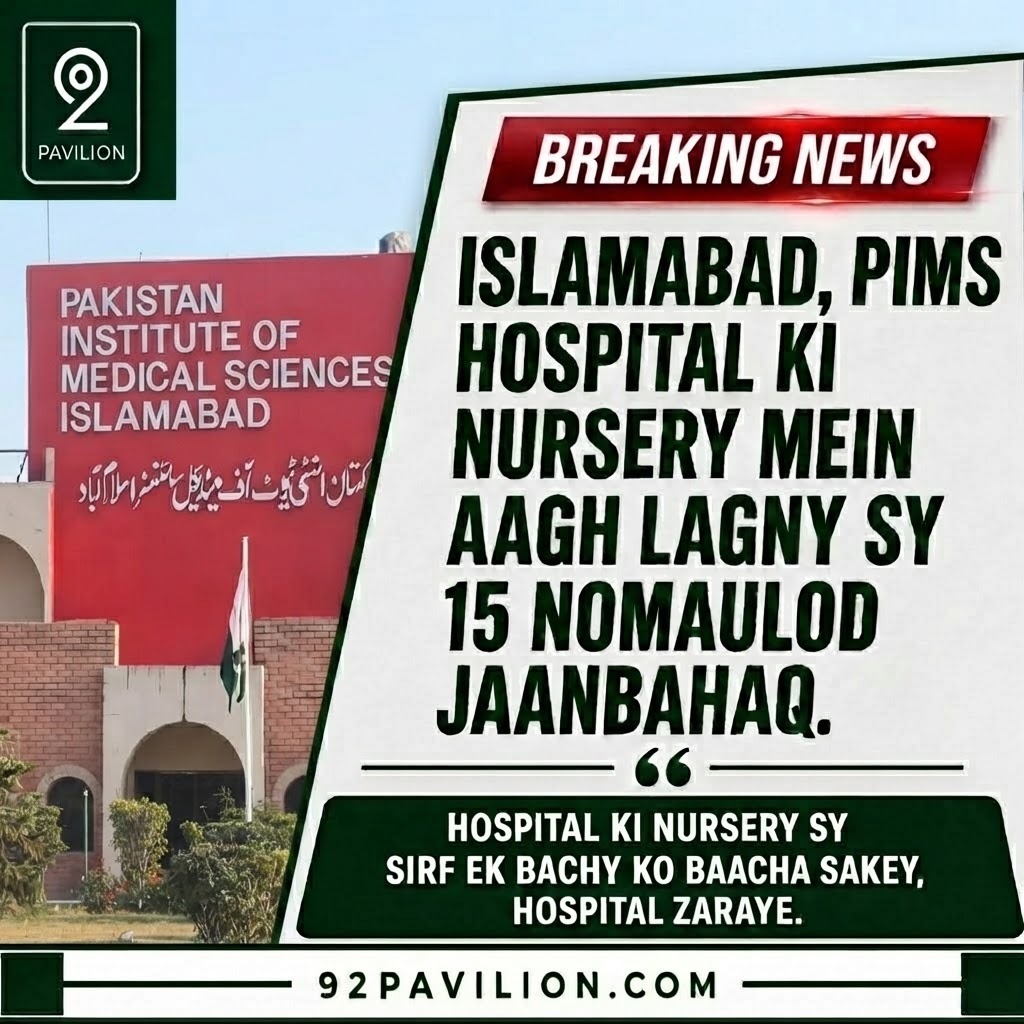
Quick Answer: A PIMS hospital fire killed 14 newborn babies in Islamabad on Wednesday, August 26. The blaze broke out in the nursery of the Mother and Child Health ward at the Pakistan Institute of Medical Sciences. Officials say an air conditioning compressor exploded near the incubators. Fifteen babies were in the nursery at the time. Only one survived.
How the Fire Started
The fire broke out at around 6:38am on the third floor of the hospital’s Mother and Child Centre. According to a preliminary hospital report, a spark inside the nursery triggered a massive blaze within seconds. Oxygen points attached to each incubator fed the flames rapidly.
Two doctors and two nurses were on duty inside the nursery when the fire began. They immediately called security staff for help. Together, they tried twice to reach the babies before a huge blast occurred and the ceiling collapsed.
The Rescue That Came Too Late
Staff managed to pull one baby from the nursery and four more from an adjacent room, along with three mothers. But for most of the newborns inside, there was no time.
Firefighters reached the scene within seven minutes of the alert. Six fire engines and four ambulances took part in the rescue operation. By then, thick black smoke had already filled the ward.
Eyewitness Abdul Ghafoor told AFP the scene was chaotic. “I barged in to try to save as many people as I could, but we could not reach the ward where the patients were,” he said. Some people broke windows just to help others escape.
Families Left With Nothing
The human toll of this tragedy is hard to overstate. Among the victims were the twin daughters of a vegetable seller named Bahadur Khan. A father named Samiullah lost his three-day-old baby.
Nurse Noreen Khan described the scene inside the ward as unbearable. “The 14 babies who had just opened their eyes to the world died just after a day or two of being alive,” she said. One mother, Mohammad Sami, had given birth just three days earlier. Her baby was in intensive care in the nursery when the fire broke out. “I don’t know what to say or who to blame,” she said through tears. “I have lost my child.”
Multiple witnesses reported finding locked doors inside the ward as the fire spread, adding to the panic and confusion during the rescue effort.
A Government Response, and Growing Anger
Prime Minister Shehbaz Sharif said he was deeply saddened by the incident and ordered an immediate investigation. Federal Health Minister Mustafa Kamal travelled from Karachi to Islamabad to personally oversee the inquiry, saying “no one responsible for negligence, including me, will be spared.”
Not everyone was satisfied with promises of an investigation. National Assembly member Sharmila Sahibah Faruqui called the tragedy “shameful and unforgivable” in a public post. “Heads must roll,” she wrote. “Please do not hide behind another inquiry committee.”
Not the First Warning Sign
This wasn’t Pakistan’s first fatal hospital fire linked to faulty air conditioning. In June 2024, a similar blaze tore through the paediatric ward of Sahiwal Teaching Hospital in Punjab, killing 11 babies. Punjab’s Chief Minister later ordered the arrest of that hospital’s medical superintendent and three senior doctors after inquiries found serious fire safety failures.
PIMS is Islamabad’s largest public-sector hospital and is generally considered better resourced than facilities elsewhere in the country. That this tragedy happened there, in what should have been the safest ward in the building, has fuelled public anger over the state of hospital infrastructure nationwide.
What Happens Next
Investigators are now working to determine exactly how the compressor explosion led to such rapid, devastating fire spread, and why the nursery’s safety systems failed to contain it. Families are still waiting for their babies’ bodies to be released after the necessary paperwork is completed.
For now, Islamabad is left mourning one of the deadliest hospital fires in Pakistan’s recent history.
Frequently Asked Questions
How many babies died in the PIMS hospital fire?
Fourteen newborns died. Fifteen were in the nursery at the time, and only one survived.
What caused the fire?
Officials say an air conditioning compressor exploded inside the nursery, igniting nearby oxygen points at each incubator.
When did the fire happen?
The fire broke out around 6:38am on Wednesday, August 26, 2026.
Has this happened before at a Pakistani hospital?
Yes. A similar air-conditioning-related fire killed 11 babies at Sahiwal Teaching Hospital in Punjab in June 2024.
This report is based on reporting from Dawn, CNN, Al Jazeera, CBS News, and The Express Tribune.
92Pavilion extends its deepest condolences to the families affected by this tragedy. We will continue following this story as the investigation develops.