By: News Desk 92Pavilion
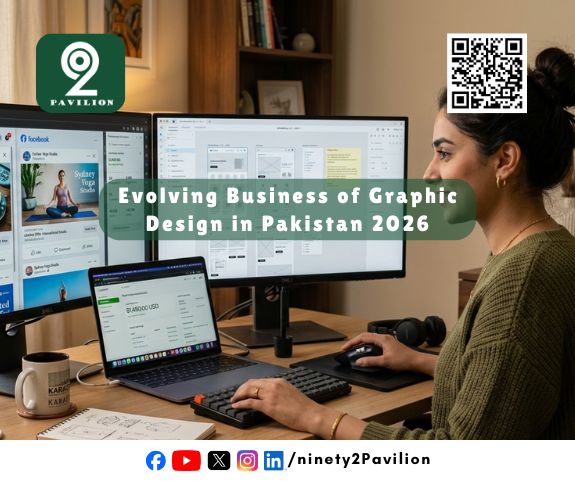
In the current business landscape of April 2026, graphic design in Pakistan has transcended its origins as a creative service to become a core pillar of the nation’s digital export economy. With the global graphic design market valued at nearly 60 billion dollars this year, Pakistani designers have secured a significant foothold by pivoting from static imagery to multi-dimensional, AI-integrated visual strategies. The running business situation in Pakistan is characterized by a “Dual-Market Mastery” where local studios are simultaneously servicing a booming domestic e-commerce sector and a high-demand international freelance market. For a professional graphic designer in Pakistan today, the path to monetization is no longer restricted to simple logo creation; it involves the development of comprehensive brand ecosystems that include motion graphics, 3D product visualizations, and interactive UI/UX interfaces.
Earnings for Pakistani designers in 2026 are increasingly driven by “Performance-Design Retainers.” Local brands in Lahore, Karachi, and Faisalabad, facing intense competitive pressure, are now willing to pay a premium for designers who can demonstrate a direct link between visual quality and marketing ROI. A mid-career graphic designer in the local corporate sector currently earns an average total compensation of approximately 780,000 PKR annually, while elite freelancers operating on international platforms like Upwork and specialized 2026 “design-as-subscription” models are earning significantly more, often in US Dollars. This “Dollar-Income” model has become the primary goal for many, as it provides a robust financial buffer against local inflation. To maximize these earnings, Pakistani creators are moving beyond basic tools and mastering advanced software for AR/VR and “Chaos Packaging”—a 2026 trend that favors loud, layered, and maximalist brand identities over the sterile minimalism of previous years.
The business situation has also been profoundly reshaped by the “Human-AI Collaboration” mandate. In the current market, the most successful designers are those who use generative AI to automate repetitive tasks like image resizing, background removal, and layout variations, allowing them to focus on high-level creative direction and strategic storytelling. This shift has created a new revenue stream: “AI Design Consultation,” where designers advise local SMEs on how to integrate AI assets into their branding without losing their unique human touch. Additionally, the “Social-First” content wave has sustained a massive recurring demand for short-form video assets and animated social templates, with businesses allocating nearly 45% of their design budgets specifically for marketing and social media visuals.
Furthermore, the rise of “Hyper-Local E-commerce” within Pakistan has opened doors for specialized packaging and merchandise designers. As local entrepreneurs launch niche product lines for a mobile-first audience, they require designers who understand both international aesthetics and local cultural nuances, such as using Roman Urdu in ad creative. To earn money in this environment, designers are also diversifying into passive income through print-on-demand platforms, selling locally-inspired digital artwork to a global audience. In summary, the graphic design business in Pakistan in 2026 is a mature and highly competitive field that rewards technical versatility and strategic thinking. It is an industry where creativity opens the door, but an understanding of performance metrics and emerging immersive technologies sustains the business, making it a cornerstone of the modern Pakistani professional landscape