
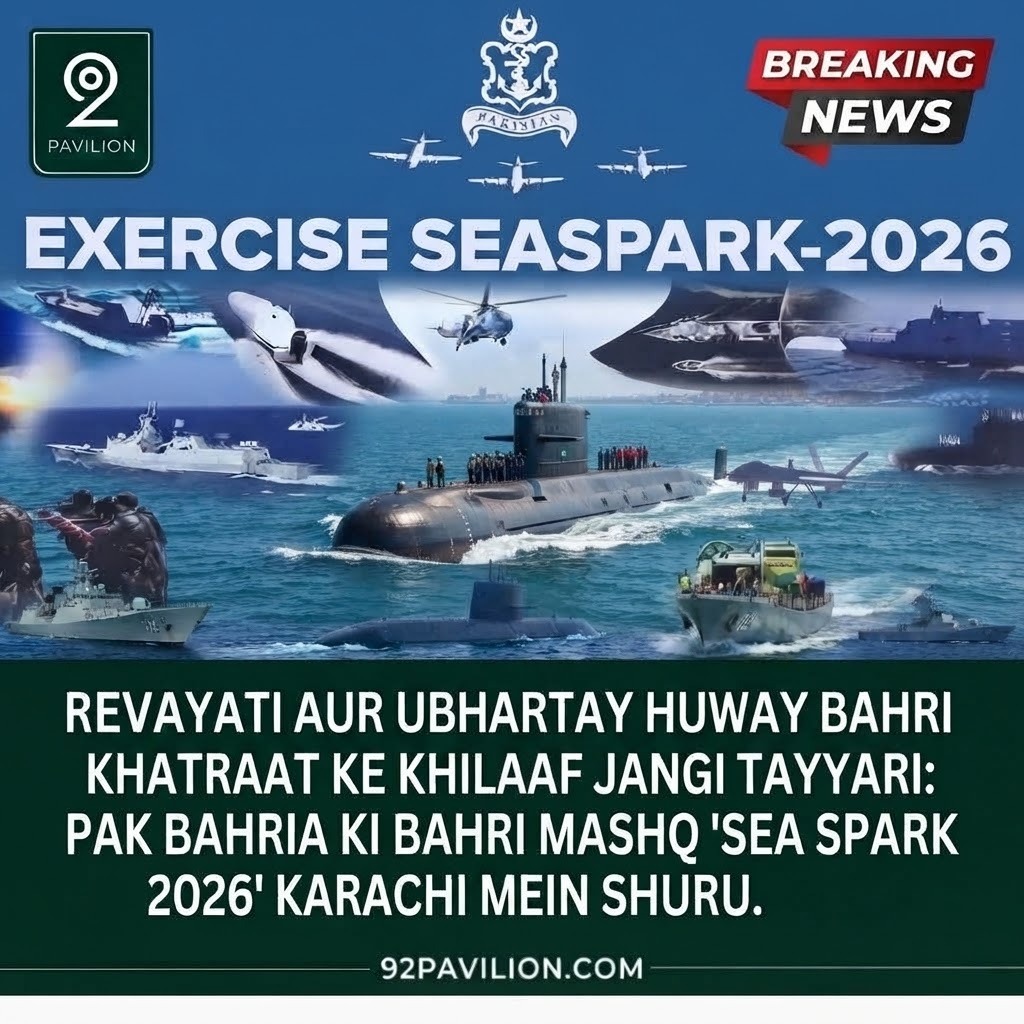
Quick Answer: Pakistan Navy has launched its major tri-service maritime exercise, Sea Spark 2026, in Karachi, bringing together warships, submarines, fighter aircraft, drones, Marines, and special forces to assess combat readiness against modern maritime threats. The exercise officially began on September 2, 2026, with Chief of Naval Staff Admiral Naveed Ashraf as chief guest.
What Is Exercise Sea Spark 2026
Sea Spark is a recurring Pakistan Navy exercise, held roughly every two years, designed to test the operational readiness of naval, army, and air force assets working together. The 2026 edition is being described as one of the largest in the series, combining traditional maritime warfare drills with multi-domain elements covering cyber, information, and space capabilities.
Key Highlights
- Tri-service participation: Personnel and assets from the Pakistan Navy, Pakistan Army, and Pakistan Air Force are jointly taking part, alongside Pakistan Marines and special forces.
- Assets involved: The exercise features warships, submarines, fighter aircraft, and drones.
- Chief guest: Chief of the Naval Staff Admiral Naveed Ashraf led the opening briefing and inspected fleet units ahead of the exercise.
- Focus area: A central theme of Sea Spark 2026 is multi-domain warfare — integrating maritime, air, land, cyber, information, and space operations into a single coordinated framework.
Why This Exercise Matters
Speaking at the opening briefing, Admiral Naveed Ashraf said the Pakistan Navy could not afford to compromise on operational preparedness given the region’s unstable and complex security environment. He also stressed the growing importance of the information domain in modern conflict and the need for close coordination among the three armed forces.
The exercise carries added strategic weight for Pakistan given how heavily the country’s trade and economic activity depend on secure maritime routes in the Indian Ocean region.
What Happens During the Exercise
- Review and inspection of ongoing operational activities aboard Pakistan Navy warships.
- Joint operational planning exercises between the Navy, Army, and Air Force.
- Simulated responses to both conventional and modern (cyber, drone-based, and electronic) maritime threats.
- Coordination drills aimed at improving decision-making speed and information-sharing across the three services.
FAQs
Q: What is Exercise Sea Spark?
Sea Spark is a periodic Pakistan Navy-led tri-service exercise held in Karachi, first conducted in 2012, aimed at testing naval and joint-force combat readiness.
Q: When did Sea Spark 2026 begin?
The exercise officially began on September 2, 2026, in Karachi.
Q: Which forces are participating in Sea Spark 2026?
The Pakistan Navy, Pakistan Army, and Pakistan Air Force are all taking part, along with Marines and special forces units.
Q: What is the main focus of this year’s exercise?
Sea Spark 2026 places particular emphasis on multi-domain warfare, integrating maritime, air, land, cyber, information, and space capabilities.
This report is based on official statements from Pakistan Navy and ISPR-linked media coverage. Updates will follow as the exercise progresses.