By: Sardar Shoukat Popalza. President, Balochistan Economic Forum
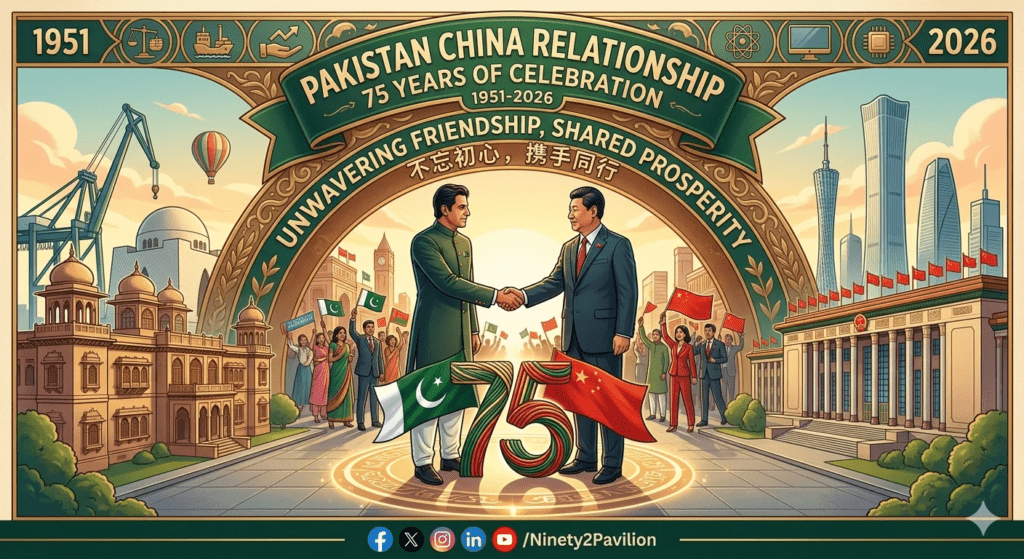
As Pakistan and China mark 75 years of diplomatic relations, the phrase ‘Iron Brothers’ is not merely diplomatic language. It reflects a partnership tested by history, strengthened by geography, and carried forward by shared strategic interests. For Pakistan, this relationship has produced defence cooperation, infrastructure development, energy projects, diplomatic support and long-term economic confidence. For China, Pakistan remains a trusted neighbour, a gateway to the Arabian Sea, and a central partner in the Belt and Road vision.
But if there is one province where the future of China-Pakistan relations will be most visibly tested, it is Balochistan.
Balochistan is not just Pakistan’s largest province by area. It is Pakistan’s maritime opening, mineral frontier, energy corridor, fisheries belt and future logistics bridge to Central Asia, the Middle East and western China. The success of the next 75 years of China-Pakistan friendship will depend heavily on whether Balochistan becomes a genuine beneficiary of that relationship.
BALOCHISTAN AT THE CENTRE OF CHINA-PAKISTAN CONNECTIVITY
The China-Pakistan Economic Corridor, launched as the flagship of the Belt and Road Initiative, gave Balochistan a historic place in regional economic geography. Gwadar Port, the Gwadar Free Zone, road connectivity, airport infrastructure, and planned industrial development have placed the province at the centre of Pakistan’s long-term connectivity strategy. The official CPEC portfolio continues to list Gwadar projects including the development of Gwadar Port and Free Zone, Gwadar Smart Port City Master Plan, Pak-China Technical and Vocational Institute, Eastbay Expressway, and supporting infrastructure.
This is why Gwadar is more than a port. It is a national idea. It represents Pakistan’s ambition to connect western China, Afghanistan, Central Asia, the Gulf, Iran and the Arabian Sea through a modern trade and logistics network. For Balochistan, Gwadar offers the possibility of moving from the margins of development to the centre of regional commerce.
The new operational phase of this relationship is also becoming more structured. In May 2026, Pakistan and China agreed on a CPEC Phase-II investor coordination mechanism, under which Pakistan’s Board of Investment will share project details with the Chinese Embassy, while the Embassy will help connect suitable Chinese investors with Pakistani opportunities. This is important for Balochistan because the province needs not only roads and ports, but also factories, processing units, cold chains, mineral upgradation, fisheries value addition, renewable energy and export-oriented industrial zones.
FROM INFRASTRUCTURE TO INDUSTRIALISATION
The first phase of CPEC helped Pakistan address important infrastructure and energy gaps. The second phase must now move toward industrial cooperation, agriculture, technology, mineral processing, green energy and people-centred development.
For Balochistan, this shift is essential. The province does not need development that only passes through it. It needs development that stays in Balochistan, employs local people, trains local youth, supports local entrepreneurs and creates exportable products from local resources.
Balochistan’s mineral wealth is internationally recognised. Copper, gold, chromite, coal, iron ore, marble, granite, antimony and other minerals provide the foundation for a major industrial transformation. However, the province cannot progress if minerals are exported only in raw form. China’s experience in mineral processing, industrial parks, logistics, machinery, technical training and export chains can help Balochistan move from extraction to value addition.
A positive China-Pakistan agenda for Balochistan should therefore include:
1. Mineral stockpile and upgradation zones near Gwadar, Hub, Khuzdar, Chagai and Karachi-linked corridors.
2. Chinese-supported testing, grading and certification laboratories for export-quality minerals.
3. Joint ventures between Chinese companies and Balochistan mine owners for responsible mining.
4. Technical institutes for mining machinery, safety and processing skills.
5. Transparent ESG standards to protect local communities and build investor confidence.
This would make Balochistan not merely a supplier of raw minerals, but a serious participant in regional industrial supply chains.
GWADAR: PORT FIRST, PEOPLE ALWAYS
Gwadar remains the symbolic heart of CPEC. Yet the strongest future for Gwadar will not come from buildings alone. It will come when the people of Gwadar feel ownership of development.
The people of Gwadar have a rich maritime history, a fishing economy, and deep cultural roots. Any development model must protect their dignity, livelihood and participation. The future of Gwadar should be built on the principle: Port first, but people always.
That means China-Pakistan cooperation in Gwadar should prioritise clean water, reliable electricity, modern health facilities, technical education, fisheries infrastructure, boat repair yards, cold storage, seafood processing plants, coastal tourism, and youth employment.
The New Gwadar International Airport, supported by China under the Belt and Road framework, is a major infrastructure milestone for the province. The airport became operational in 2025 and is Pakistan’s largest airport by area, with capacity for domestic and international aircraft and around 400,000 passengers annually. This facility can transform Gwadar only if it is connected with trade, tourism, fisheries, logistics and local business opportunities.
Gwadar should not remain only a transit point. It should become a living economic city.
BLUE ECONOMY: A NATURAL BRIDGE BETWEEN CHINA AND BALOCHISTAN
Balochistan’s coastline is one of Pakistan’s greatest underutilised assets. From Gwadar to Pasni, Ormara, Jiwani and beyond, the province has a natural base for fisheries, seafood exports, marine services, coastal tourism and ship repair.
China has one of the world’s largest seafood markets and advanced experience in marine processing, aquaculture, cold-chain logistics and port-based industrial clusters. This creates a major opportunity for Balochistan province.
A serious China-Pakistan blue economy partnership should focus on:
1. Modern fish landing sites.
2. Ice plants and cold storage facilities.
3. Seafood processing and packaging units.
4. Training for fishermen in quality control and export standards.
5. Marine research centres in Gwadar and Lasbela.
6. Coastal tourism linked with local communities.
7. Environmentally responsible ship recycling and marine services.
This would directly benefit coastal communities and reduce the gap between mega-projects and local livelihoods.
SECURITY: FROM PROTECTION TO PARTNERSHIP
Security remains the most sensitive challenge facing China-Pakistan cooperation in Balochistan province. Chinese nationals and CPEC-linked projects have been targeted in recent years, creating understandable concerns in Beijing and Islamabad. A positive report on China-Pakistan relations cannot ignore this reality. But the answer is not to slow development. The answer is to make development more secure, more inclusive and more locally trusted.
Security must be built on three pillars:
First, professional protection. Chinese workers, engineers and investors must receive reliable, coordinated and intelligence-led security.
Second, local inclusion. When local communities benefit from employment, contracts, training and services, they become natural stakeholders in project protection.
Third, strategic communication. Pakistan and China must jointly explain projects in local languages, address misinformation, and demonstrate visible benefits for ordinary citizens.
The most secure CPEC will be the one that Balochistan’s people see as their own.
CPEC 2.0 AND BALOCHISTAN’S PRIVATE SECTOR
The first CPEC phase was largely state-to-state. The second phase must become business-to-business and people-to-people.
Balochistan’s private sector, tribal business families, mine owners, fisheries exporters, transporters, agriculture entrepreneurs and youth startups must be connected with Chinese investors. Without local business participation, CPEC will remain too dependent on government structures.
The newly agreed investor coordination mechanism under CPEC Phase-II can become a turning point if Balochistan receives special attention in project matching. The Board of Investment, Chinese Embassy, Balochistan government, Gwadar Port Authority, Balochistan Economic Forum and private sector associations should work together to prepare bankable projects.
Priority sectors for Balochistan should include:
1. Minerals processing and certification.
2. Fisheries and seafood exports.
3. Solar and wind energy.
4. Dates, olives, fruits and livestock value chains.
5. Logistics and bonded warehousing.
6. Gwadar Free Zone industries.
7. Technical training and vocational education.
8. Tourism and hospitality.
9. Green ship recycling at Gadani.
10. Security technology and safe-city systems.
This is how CPEC 2.0 can move from promises to measurable economic activity.
FINANCIAL CONFIDENCE AND NEW INSTRUMENTS
The China-Pakistan relationship is also entering a financial phase. In May 2026, Pakistan completed its first Panda Bond issuance in China’s domestic market, supported by the Asian Infrastructure Investment Bank and the Asian Development Bank. AIIB stated that the bond would help Pakistan diversify external financing and mobilise capital for sustainable infrastructure development.
This is relevant for Balochistan because the province requires long-term financing for climate-resilient infrastructure, renewable energy, water systems, logistics, ports, roads and industrial zones. If properly designed, future green financing, Panda Bonds and Chinese-backed investment instruments could support projects in Gwadar, coastal Balochistan, mining districts and climate-vulnerable areas.
Balochistan needs development finance that is transparent, commercially viable and socially responsible.
A FRIENDSHIP THAT MUST DELIVER LOCALLY
China and Pakistan often describe their relationship as higher than mountains and deeper than oceans. For Balochistan, the mountains and oceans are not just poetic descriptions. They are reality.
1. The mountains contain minerals.
2. The ocean carries trade.
3. The coastline supports fishermen.
4. The highways connect markets.
5. The port opens Pakistan to the world.
6. The youth represent the province’s future.
The next stage of China-Pakistan friendship must therefore be judged by its local impact. It must answer simple questions:
– Has Gwadar’s youth received skills and jobs?
– Have fishermen received modern facilities?
– Have local businesses joined Chinese supply chains?
– Have minerals been processed locally?
– Have communities gained water, electricity, health and education?
– Have investors found a secure and predictable environment?
– Has Balochistan become a partner, not merely a passage?
If the answer becomes yes, then CPEC will truly be remembered as a game changer.
CONCLUSION: BALOCHISTAN PROVINCE AS THE GATEWAY TO PROSPERITY
The China-Pakistan relationship was built on trust, strategic necessity and shared interests. It survived wars, sanctions, global shifts, political changes and economic crises. Now it faces a new test: whether it can become more inclusive, more local and more development-oriented.
Balochistan province is the natural bridge to the future of China-Pakistan relations. It connects the Karakoram to the Arabian Sea, minerals to industry, Gwadar to Kashgar, and local hopes to regional opportunity.
For Pakistan, the task is to create security, transparency, local ownership and investor facilitation. For China, the opportunity is to deepen goodwill by supporting projects that visibly improve lives. For Balochistan, the moment is historic: to transform its geography from a challenge into an advantage.
The friendship between China and Pakistan has already proved durable. The next chapter must prove developmental.
And that chapter can begin from Balochistan province. -Ends-