Latest Posts
Building a Vibrant Cultural FutureA Journey Towards ProsperityArab nations face an inevitable declineBlogging Revenue in Pakistan’s 2026 EconomyWhy China is Investing in Pakistan’s Gwadar PortThe Rising Spirit of Pakistani SportsVoice-Over Economy in Pakistan 2026India’s Investment in Iran,Chabahar PortEvent Management Business in Pakistan 2026The Volatile Trajectory of Pakistan-Afghanistan Relations in 2026Why Pakistan Must Overhaul Its InfrastructureEvolution of Goods and Equipment in Modern SportsThe Current Situation of Sports in PakistanGovernment Initiatives for Sports in PakistanAssessing Sports Infrastructure and Facilities in PakistanSialkot and the Renaissance of Pakistan’s Sports Goods IndustryEmerging Sports Trends in 2026Legacy of Popular Traditional SportsJourney Through the Background of Sports in PakistanInfrastructure and Framework Deficits in Pakistani Sports InstitutionsLevelling the Field of SportsThe Roadmap for Pakistan’s Islamic Financial TransitionApartheid Structure in Occupied KashmirThe Strategic Role of the SCO in 2026Complexities of Illegal Immigrant RepatriationPakistan’s Strategic Role in Regional Power DynamicsPakistan’s Strategic Role in the South Asian Power PlayPakistan’s Strategic Tightrope in the US-China RivalryPakistan-China Relations in a Changing Geopolitical EnvironmentForeign Relation of Pakistan with Neighboring CountriesGlobal Response and the Reshaping World Order in 2026Impacts of International Structure on Pakistan’s Foreign PolicyEnduring Conflict Between India and PakistanAncient Roman and Modern EntertainmentCultivating Pakistan’s Future Tech WorkforceBuilding, Champions of the WorldDeciphering the Boundary Between Art and EntertainmentDevelopment of Pakistan’s Entertainment Industry

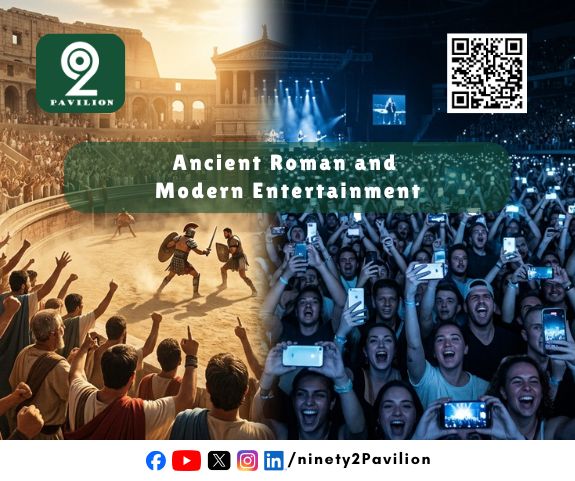
Ancient Roman and Modern Entertainment

Ancient Roman and Modern Entertainment

By: News Desk 92Pavilion

The human desire for diversion is a constant thread that binds the distant past of Ancient Rome to the high-tech reality of 2026. While the methods of delivery have shifted from stone amphitheatres to digital clouds, the underlying psychology of entertainment—the craving for shared spectacle, competitive thrill, and emotional escape—remains remarkably consistent. In Ancient Rome, entertainment was a tool of political stability, famously encapsulated by the satirical poet Juvenal as “bread and circuses.” Today, while the stakes of survival have changed, entertainment remains the primary vehicle through which society processes its values and finds respite from the pressures of modern life.

In the Roman world, the pinnacle of entertainment was the live, visceral spectacle. The Colosseum, which could hold upwards of 50,000 spectators, was the epicenter of gladiatorial combat, while the Circus Maximus hosted chariot races for crowds exceeding 150,000. These events were multisensory experiences: the smell of sawdust, the roar of the crowd, and the visual drama of life-and-death stakes. These ludi, or public games, were often free to the citizens, funded by the elite to secure public favor and distract the populace from political unrest. They provided a sense of social cohesion and a release for collective aggression, functioning as the ultimate “live event” that dictated the rhythm of urban life.

Fast forward to 2026, and the “stadium” has become both a physical landmark and a virtual space. While we still gather in massive arenas for football or concerts, a significant portion of modern entertainment is consumed in the “infinite amphitheatre” of the digital world. The bloodlust of the gladiator pits has been sublimated into the high-stakes world of professional e-sports and hyper-realistic gaming. Instead of physical chariots, we witness the digital precision of simulation racing. The “bread” of the past has evolved into the “subscription model,” where for a monthly fee, citizens have unlimited access to a digital buffet of films, music, and interactive media. Yet, the core appeal remains the same: the thrill of the contest and the communal experience of watching a master at their craft.

The most profound difference lies in the democratization and personalization of the experience. Roman entertainment was a top-down affair, curated by the state and dictated by the calendar. In 2026, technology has handed the remote to the individual. Through AI-driven personalization and mobile connectivity, entertainment is no longer a scheduled pilgrimage to a stone arena; it is a constant, ambient companion. We have moved from the “mass spectacle” to the “personalized niche,” where algorithms curate a private Colosseum of content for every user. However, even in this fragmented landscape, the “event” still reigns supreme. Whether it is a global streaming premiere or a virtual reality concert, we still seek those moments that allow us to feel part of something larger than ourselves.

Ultimately, the transition from Ancient Rome to today reveals that while our tools have become more sophisticated and our morals more refined, our nature is unchanged. We are still a species that gathers to watch a story unfold, to cheer for a champion, and to escape the mundane through the power of performance. Whether stone or silicon, the arena remains the heart of the human experience

Share

Introduction

Pakistan’s political environment in 2026 remains dynamic and highly influential in shaping the country’s future. From parliamentary debates and economic policy decisions to opposition movements and electoral reforms, recent developments are playing a crucial role in determining national direction.

In this report by Eye of Pakistan, we analyze the latest political developments, government strategies, and opposition responses.

Government’s Policy Priorities in 2026

The federal government has emphasized:

  • Economic stabilization

  • Institutional reforms

  • Energy sector restructuring

  • Strengthening foreign diplomatic ties

Recent cabinet meetings focused on controlling inflation, stabilizing the Pakistani Rupee, and implementing fiscal discipline under ongoing economic reform programs.

Officials claim these measures aim to restore investor confidence and ensure sustainable growth.

Opposition’s Response and Political Strategy

Major opposition parties have intensified criticism of government policies, particularly regarding:

  • Rising inflation

  • Unemployment

  • Tax reforms

  • Utility price increases

Opposition leaders argue that economic pressure on the public has increased and demand greater transparency in parliamentary proceedings.

Political rallies and public gatherings have increased across major cities including Karachi, Lahore, and Islamabad.

Parliamentary Developments

Recent National Assembly sessions have seen heated debates over:

  • Budget allocations

  • Electoral reforms

  • Accountability laws

  • Provincial autonomy issues

Lawmakers from both treasury and opposition benches continue to exchange strong viewpoints, reflecting a vibrant yet tense political atmosphere.

Election Reforms and Democratic Process

Discussions around electoral transparency and digital voting mechanisms remain central to political discourse.

The Election Commission is reportedly reviewing:

  • Voter verification systems

  • Polling station security

  • Overseas voting procedures

Analysts believe these reforms could significantly impact future general elections.

Public Reaction and Political Climate

Public opinion appears divided. While some citizens support structural reforms and long-term stabilization plans, others express concerns over economic hardships and governance challenges.

Political analysts suggest that the coming months will be critical in determining whether current policies translate into tangible relief for the public.

Conclusion

Pakistan’s political landscape in 2026 is marked by active debate, institutional reforms, and strategic maneuvering from both government and opposition parties. As policy decisions continue to unfold, their impact on economic stability and democratic processes will remain under close observation.

Stay connected with Eye of Pakistan for reliable and timely political updates.

Education in Pakistan 2026

By: News Desk 92Pavilion Education in Pakistan stands as a complex paradox of modest statistical gains and deep-rooted systemic crises. As of 2026, the national

Share
Read More »